

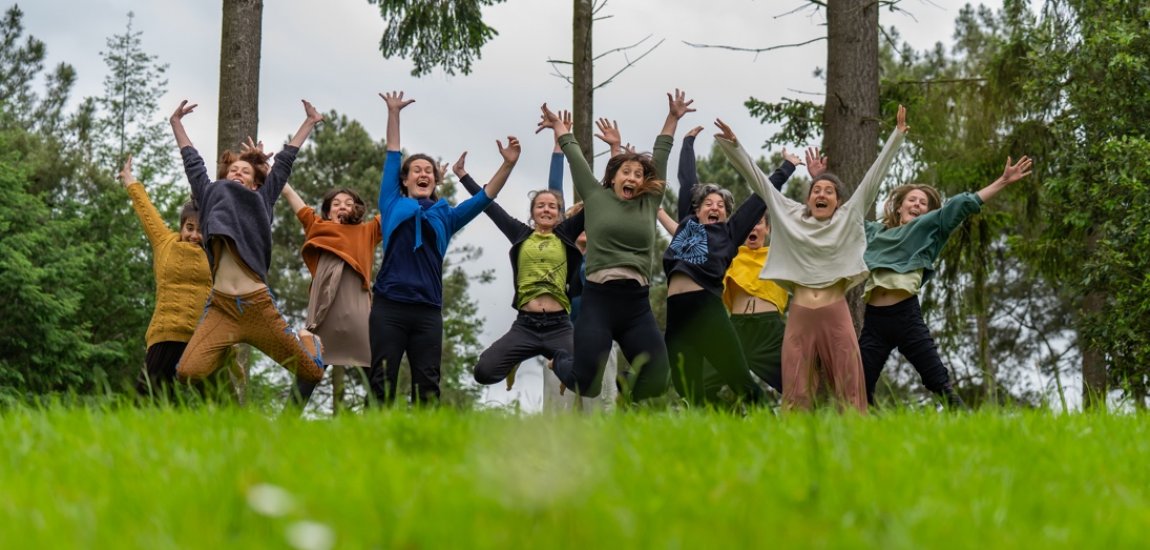
FORMATION/TRAINING  Approche Anam Cara
Formation/Dance Training - Transmission de l'Approche Anam Cara® - Danse, nature & rituels artistiques contemporains

Formation/Dance Training - Transmission de l'Approche Anam Cara®

Danse, nature & rituels artistiques contemporains

( english version below: classes may be taught in both French and English)

Au croisement de la danse et de l’écologie somatique, 
entre pratiques somatiques et écopsychologie, cette transmission est un processus d’enseignement artistique où la danse, l’art et notre lien à la nature s’entrelacent.
Elle tisse un pont entre Art, Vie & Engagement, invitant à une exploration sensible et immersive.

Son approche pédagogique est multimodale, convoquant la danse, le travail de la voix, l’écriture créative, les arts plastiques et le land-art, jusqu’à l’art de la création artistique sous toutes ses formes – de l’improvisation à la performance, du solo aux rituels collectifs. Elle encourage la recherche et la réflexivité, permettant aux participant.e.s de s’approprier pleinement les processus de l’Approche Anam Cara®, inscrite dans la lignée d’Anna Halprin.

Ancrée dans une pédagogie globale, ce cycle long de formation   associe transmission théorique et expériences immersives en nature, pour offrir de réelles compétences professionnelles au service de la création artistique, de l’art de la performance en milieu naturel et de l’Art Social – ces actes artistiques participatifs et collectifs ouverts à tous les publics.


Une transmission née d’un long cheminement:

L’Approche Anam Cara® est l’aboutissement d’un rêve nourri par quarante années de recherche en danse, chorégraphie et art social. Ce cheminement personnel et professionnel m’a menée, en 2007, à la rencontre d’Anna Halprin, qui est devenue une mentor essentielle pour affiner et approfondir cette exploration de la danse en résonance avec la nature et la société. 

De cette relation privilégiée est née en 2011 une résidence de recherche-création au Mountain Home Studio (Californie) avec ma compagnie Alluna. Nous y avons créé la pièce A Time for Everything et donné naissance à un rituel inédit, le "Humantra", jamais retransmis à ce jour.

Ce dialogue entre art et vie, porté par Anna Halprin tout au long de sa carrière, continue d’inspirer mon enseignement. À travers l’Approche Anam Cara®, je cherche à tisser les liens entre les pratiques somatiques, la danse, et une conscience écologique profonde, afin de proposer une vision renouvelée du rôle de l’artiste dans notre monde en mutation.


Danse et écologie somatique : une nécessité pour notre époque

Nous traversons une époque de bouleversements qui exige une transformation de nos récits et de nos imaginaires. L’Approche Anam Cara® entend former des artistes capables de :

  • Réinventer la danse comme un outil d’interaction avec le vivant, où le corps devient un espace de résonance avec l’environnement.
  • Créer des performances engagées, qui participent à la transition écologique et à une réflexion sur notre place dans le monde.
  • Explorer l’"éco-poétique du geste", nourrie par une écoute sensible des espaces traversés.
  • Travailler hors des cadres conventionnels, en développant des pratiques immersives en nature, loin d’une simple mise en scène du paysage comme décor.

Loin d’être réservée aux danseurs professionnels, cette formation s’adresse à toute personne ayant un engagement artistique et corporel : artistes (danseurs, comédiens, plasticiens, circassiens), éducateurs, praticiens somatiques, enseignants du mouvement, ou encore étudiants en quête d’une approche innovante.

Une première promotion s'est déroulée de Mars 2022 à Octobre 2024. La seconde promotion est encours depuis Mars 2025 , elle  finira en Octobre 2027 .

La prochaine formation commencera en Mars 2028 .
Chaque promotion accueille 18 personnes maximum.

Les prochaines candidatures pour 2028 sont ouvertes.  


Un apprentissage vivant, en perpétuelle évolution

L’Approche Anam Cara® se veut vivante et évolutive, en constante recherche avec les enseignants intervenants et les étudiants-chercheurs qui s’en empareront. Elle ouvre un espace pour questionner, expérimenter, créer et transmettre.

                             Parce que danser, c’est aussi prendre soin du monde.

***

At the intersection of dance and somatic ecology,

between somatic practices and ecopsychology, this program is an artistic teaching process where dance, art, and our connection to nature intertwine.

It builds a bridge between Art, Life & Engagement, inviting participants to engage in a sensory and immersive exploration.

Its pedagogical approach is multimodal, drawing on dance, voice work, creative writing, visual arts, and land art, extending to the art of artistic creation in all its forms—from improvisation to performance, from solo work to collective rituals. She encourages research and self-reflection, enabling participants to fully embrace the processes of the Anam Cara® Approach, rooted in the tradition of Anna Halprin.

Rooted in a holistic pedagogy, this long-term training program combines theoretical instruction with immersive experiences in nature to provide genuine professional skills in the service of artistic creation, performance art in natural settings, and Social Art—those participatory and collective artistic acts open to all audiences.

A legacy born of a long journey:

The Anam Cara® Approach is the culmination of a dream nourished by forty years of research in dance, choreography, and social art. This personal and professional journey led me, in 2007, to meet Anna Halprin, who became an essential mentor in refining and deepening this exploration of dance in resonance with nature and society.

From this special relationship emerged, in 2011, a research-creation residency at Mountain Home Studio (California) with my company Alluna. There we created the piece A Time for Everything and gave birth to a unique ritual, the “Humantra,” which has never been performed since.

This dialogue between art and life, championed by Anna Halprin throughout her career, continues to inspire my teaching. Through the Anam Cara® Approach, I seek to weave connections between somatic practices, dance, and a deep ecological consciousness, in order to offer a renewed vision of the artist’s role in our changing world.

Dance and Somatic Ecology: A Necessity for Our Time

We are living in a time of upheaval that demands a transformation of our narratives and our imaginations. The Anam Cara® Approach aims to train artists capable of:

  • Reinventing dance as a tool for interacting with the living world, where the body becomes a space of resonance with the environment.
  • Create socially engaged performances that contribute to the ecological transition and to a reflection on our place in the world.
  • Explore the “eco-poetics of gesture,” nourished by a sensitive listening to the spaces traversed.
  • Work outside conventional frameworks, developing immersive practices in nature, far from a mere staging of the landscape as a backdrop.

Far from being reserved for professional dancers, this program is open to anyone with an artistic and physical commitment: artists (dancers, actors, visual artists, circus performers), educators, somatic practitioners, movement teachers, or students seeking an innovative approach.

The first cohort ran from March 2022 to October 2024. The second cohort has been underway since March 2025 and will conclude in October 2027.

The next training program will begin in March 2028.

Each cohort accepts a maximum of 18 participants.

Applications for the 2028 cohort are now open.

A dynamic, ever-evolving learning experience

The Anam Cara® Approach is designed to be dynamic and evolving, constantly evolving through the collaboration of the instructors and the student-researchers who embrace it. It creates a space for questioning, experimenting, creating, and sharing.

Because dancing is also about caring for the world.


(@ crédit photos  & vidéo : Jérémy Deplagne photographe caméraman gdplgn.production)  

L'histoire de l'Approche AnamCara®/History

Pour une croissance du vivant par l'art : 
La danse comme une science, une philosophie et un art,
Poser la danse, l'art et la création au service des enjeux humains et sociétaux actuels.

L'Approche AnamCara® est une formation professionnelle en danse que j'ai longuement rêvée et murie … alchimie de mon parcours de danseuse, chorégraphe, chercheuse buissonnière «d'autres chemins de danse» depuis plus de 40 ans .

Aujourd'hui il me semble important de participer au développement de cette conscience artistique-écologique en plein développement. Participer à la création un nouveau positionnelent de la danse, invitant la personne Actant/Créateur/Artiste à être conscient de sa propre vie, de sa place dans le monde et de sa projection dans le temps pour les générations futures.

En effet ces nouvelles pratiques somatiques et artistiques , reliée par essence à la nature, - puisque nous sommes une  "part" de la nature  - peuvent répondre à des enjeux essentiels de santé publique et contribuer au développement d'une conscience éco-artistique développée : la théorie de "l'écologie somatique" que je transmets dans cette formation repose sur l'hypothèse que si le le corps est valorisé comme une "source de connaissances", un système plus équilibré sur le plan écologique et une véritable relation, peuvent émerger entre l'humanité et la nature. Les fondements théoriques de "l'écologie somatique" incluent des théories sur l'éthique environnementale , l'étude de l'histoire du corps dans la société occidentale et l'étude des pratiques somatiques. Les théories de l'écologie profonde et de l'écoféminisme exposent depuis longtemps déjà l'importance de l'individu humain dans l'éthique environnementale. Ces théories, étudiées de concert avec l'histoire de la façon dont la société occidentale est arrivée à la relation actuelle au corps- et à la danse- donnent des raisons de considérer vraiment les méthodes somatiques (jusqu'au mouvement dansé) pour faire face à la crise environnementale actuelle; pour que les enfants, les jeunes , les adultes retrouvent une véritable relation d'appartenance  à la nature, pas seulement comme un joli décor , ou un espace à patrimonialiser  ...

Il est d'ores et déjà en effet facile d'observer combien l'influence "des somatiques" est devenue de plus en plus significative même au-delà du domaine de la danse et du mouvement  : dans les domaines  de la psychologie, de la thérapie corporelle , de la médecine, du travail social...

J'ai construit la trame profonde de cet enseignement dans la continuité de ma recherche personnelle depuis toujours entre danse, somatique et art social ... Recherche eà la fois personnelle et professionnelle qui m'a amenée en 2007 à ma rencontre avec Anna Halprin . Rencontre décisive, point d'origine d'une relation forte et privilégiée où Anna Halprin est véritablement devenue mon mentor pour questionner, affiner, développer ce thème vital pour moi « Danse, Nature et Art social ».

En 2011 pour donner suite à plusieurs temps de travail-recherche ensemble, Anna m'a invitée et accueillie pendant 2 semaines avec ma compagnie « Alluna » pour une résidence de recherche-création. En plus de la pièce, « A time for everything » que nous avons créée pendant cette résidence, cette collaboration a abouti à la co-création d'un nouveau rituel de mouvement inédit, créé et joué pour cette pièce, qui n'a a ce jour jamais été retransmis: le "Humantra"

Ma recherche et mon enseignement ont trouvé confirmation dans la représentation du lien profond entre art et vie que n'a cessé d'affirmer Anna Halprin pendant toute sa carrière. Tout ce chemin privilégié avec elle me permet à mon tour de donner forme à mes intuitions: déployer la continuité de ce travail en y intégrant les multiples expériences, pratiques somatiques et enseignements qui ont nourri ce que je porte aujourd'hui.

Deux engagements conjoints et entièrement reliés participent de ce déploiement :

une recherche en danse sur les 2 années à venir avec l'écriture d'un ouvrage de recherche-transmission autour du Humantra et ses apports à la pédagogie de la danse et création dansée en nature.  

l'ancrage de cette formation-approche Anam Cara®,dans le paysage de la danse contemporaine,  afin de mettre en mouvement au sein de groupes d'étudiants-chercheurs l'ensemble de ces savoirs, et de poursuivre leurs transmissions.

Je souhaite cette formation vivante et évolutive, en constante recherche avec les artistes intervenant, et en interaction avec l'appropriation personnelle qu'en feront les étudiant.e.s/artistes .


***

Fostering personal growth through art:

Dance as a science, a philosophy, and an art form,

Putting dance, art, and creativity at the service of today’s human and societal challenges.

The AnamCara® Approach is a professional dance training program that I have long dreamed of and developed… an alchemy of my journey as a dancer, choreographer, and unconventional explorer of “other paths of dance” for over 40 years.

Today, it seems important to me to contribute to the development of this burgeoning artistic-ecological consciousness. To help create a new perspective on dance, inviting the individual—as actor, creator, and artist—to be mindful of their own life, their place in the world, and their legacy for future generations.

Indeed, these new somatic and artistic practices—intrinsically connected to nature, since we are a “part” of nature—can address critical public health challenges and contribute to the development of a mature eco-artistic consciousness: The theory of “somatic ecology” that I teach in this training is based on the hypothesis that if the body is valued as a “source of knowledge,” a more ecologically balanced system and a genuine relationship can emerge between humanity and nature. The theoretical foundations of “somatic ecology” include theories on environmental ethics, the study of the history of the body in Western society, and the study of somatic practices. Theories of deep ecology and ecofeminism have long emphasized the importance of the human individual in environmental ethics. These theories, studied in conjunction with the history of how Western society arrived at its current relationship to the body—and to dance—provide reasons to seriously consider somatic methods (including dance movement) as a means of addressing the current environmental crisis; so that children, young people, and adults can rediscover a genuine sense of belonging to nature, not merely as a pretty backdrop or a space to be preserved as heritage...

It is already evident how the influence of “somatic practices” has become increasingly significant even beyond the realm of dance and movement: in the fields of psychology, bodywork, medicine, social work...

I have built the core framework of this teaching as a continuation of my lifelong personal exploration of the intersection between dance, somatic practices, and social art... This research, both personal and professional, led me in 2007 to meet Anna Halprin. A decisive encounter, the starting point of a strong and special relationship in which Anna Halprin truly became my mentor, helping me to question, refine, and develop this theme that is vital to me: “Dance, Nature, and Social Art.”

In 2011, following several periods of collaborative research and work, Anna invited me and my company “Alluna” to spend two weeks with her for a research-creation residency. In addition to the piece, “A Time for Everything,” which we created during this residency, this collaboration led to the co-creation of a new, original movement ritual, created and performed for this piece, which has never been performed since: the “Humantra”

My research and teaching have found confirmation in the representation of the deep connection between art and life that Anna Halprin has consistently affirmed throughout her career. This privileged journey with her allows me, in turn, to give form to my intuitions: to unfold the continuity of this work by integrating the many experiences, somatic practices, and teachings that have nourished what I carry today.

Two joint and entirely interconnected commitments are part of this unfolding:

a two-year dance research project, including the writing of a research-and-transmission book centered on the Humantra and its contributions to dance pedagogy and dance creation in nature.


the establishment of this Anam Cara® training approach within the contemporary dance landscape, in order to set all of this knowledge in motion among groups of student-researchers and to continue its transmission.

I envision this training as a living, evolving process, in constant dialogue with the participating artists, and in interaction with the personal interpretation that the students/artists will bring to it.

La raison d'être du cycle long de transmission de l'Approche Anam Cara®/ Why Anam Cara ?

( english version below) 

La singularité de cette transmission au regard des formations existantes en danse est d'intégrer dans sa recherche et pratique artistique la dimension incontournable de notre lien d'Humain avec la Nature et de proposer un pont entre Art, Vie & Engagement.

Les formations en danse sont souvent tournées autour du geste artistique et du travail de création chorégraphique mais il existe peu de proposition-transmission vers des professionnels du spectacle vivant, visant à

- Utiliser l'approche sensible et l'imaginaire de la danse pour inventer de nouveaux récits sur le vivre-ensemble et la transition écologique .
La formation vise donc à former les artistes qui fabriquent des récits qui aident à créer des imaginaires suffisamment forts pour nous entraîner vers des modes de vie qui tiennent compte des ressources limitées de la nature et vers une société plus respectueuse du vivant et des inter-relations. 
En effet, la danse (et l'art en général), reflète notre époque. Elle est miroir de nos sociétés et le corps du danseur raconte souvent plus que tout autre le monde comme il est ou comme il vient , le but étant de « mettre en scène » les bouleversements du monde actuel, de poser et proposer un nouveau regard .
De participer par l'art et la création , par des actes artistiques engagés - artivisme, à une société respectueuse, solidaire et écologique .

- Danser "hors les murs"  avec une réflexion profonde au sujet de notre place d'humain en tant que "part" de la nature et non pas dansant dans un "joli décor" , "dans" la nature ou l'environnement présent.
De nombreux artistes proposent des spectacles, des performances en nature, avec des interactions avec le public. Les formations en danse actuelles n'abordent cependant pas les ces liens et questionnements primordiaux actuellement il me semble entre danse, nature,écoumène , écotone .... ni le lien subtil autour de ces sujets à créer interactivement avec le public .
C'est sur cela que repose la singularité de notre approche.

La formation permet aussi d'apprendre à

- Interagir avec le public selon les principes d'intelligence collective et participative

- Utiliser le vaste champ des pratiques corporelles telle que la danse et les pratiques dites "somatiques" (telles que le "Mouvement Authentique", le "Body Mind Centering", le "Mouvement Sensoriel" , le "TransArt" .)spécifiquement en environnement, permettant aux professionnels formés à ces pratiques de disposer d'un très large éventail de ressources autour du corps et du geste, tant dans la sphère expressive et créative que des apprentissages moteurs et du toucher et cela en relation avec l'environnement naturel ou urbain.

- Apporter des réponses et des compétences aux professionnels qui évoluent ou souhaitent évoluer dans ces contextes en donnant une culture générale théorique et pratique sur les pratiques corporelles, en construisant des compétences transversales permettant de mettre en œuvre ces pratiques auprès de publics divers ( s'adapter entre autre aux publics dit « fragiles/ à handicap » avec lesquels ils peuvent être amené à intervenir artistiquement ), en dotant les stagiaires d'outils spécifiques pour faire des liens théoriques et pédagogiques entre les principes de la danse, les principes somatiques et les lois organiques du vivant.

  • Soutenir les artistes dans leurs recherches autour de performances « hors les murs » pour créer avec les publics, interagir, tenir compte des éléments, du contexte d'intervention, car danser dehors demande étonnamment autant de technique que de réaliser un seul en scène dans une boite noire !


***

What sets this program apart from existing dance training programs is its integration into artistic research and practice of the essential dimension of our human connection with nature, and its aim to build a bridge between Art, Life, and Commitment.

Dance training programs often revolve around artistic movement and choreographic creation, but there are few training programs for performing arts professionals aimed at

- Using the sensory approach and the imagination of dance to invent new narratives about living together and the ecological transition.

The program therefore aims to train artists who create narratives that help build imaginaries strong enough to guide us toward lifestyles that take nature’s limited resources into account and toward a society more respectful of life and interrelationships.

Indeed, dance (and art in general) reflects our times. It mirrors our societies, and the dancer’s body often tells the story of the world as it is—or as it is becoming—more than anything else, with the goal of “staging” the upheavals of today’s world and offering a new perspective.

To contribute, through art and creation—through committed artistic acts (artivism)—to a society that is respectful, united, and ecological.

- Dancing “outside the walls” with a profound reflection on our place as humans as a “part” of nature, rather than dancing in a “pretty setting,” “in” nature, or within the present environment.

Many artists present shows and performances in natural settings, featuring interactions with the audience. However, current dance training programs do not address these connections and fundamental questions—which I believe are crucial today—between dance, nature, the ecumene, the ecotone… nor the subtle interplay surrounding these topics to be created interactively with the audience.

This is the foundation of the uniqueness of our approach.

The training also teaches participants to

- Interact with the audience according to the principles of collective and participatory intelligence

- Utilize the vast field of physical practices such as dance and so-called “somatic” practices (such as “Authentic Movement,” “Body Mind Centering,” “Sensory Movement,” and “TransArt” .) specifically in environmental settings, enabling professionals trained in these practices to draw on a very wide range of resources related to the body and movement, both in the expressive and creative spheres and in motor learning and touch, all in relation to natural or urban environments.

- Provide solutions and skills to professionals working or wishing to work in these contexts by offering a general theoretical and practical foundation in body-based practices, and by developing cross-disciplinary skills to implement these practices with diverse audiences (including adapting to so-called “vulnerable/ disabled” audiences with whom they may be called upon to engage artistically), and equipping trainees with specific tools to make theoretical and pedagogical connections between the principles of dance, somatic principles, and the organic laws of living beings.

- Support artists in their research on “outdoor” performances to create with audiences, interact, and take into account the elements and context of the performance, because dancing outdoors surprisingly requires just as much technique as performing a solo in a black box theater!


Les objectifs généraux de cette transmission / training objective

A l'issue du cycle entier de transmission , les étudiant.e.s seront capable de :

- Découvrir, Expérimenter et Intégrer des possibilités novatrices de danse en tant que "part" de la nature : pratiques nourries d'un imaginaire sensible d'écoute et de réciprocité avec l'environnement présent ( naturel ou urbain )

- Savoir considérer et moduler leur relation entre le geste dansé et le milieu et de cette façon rendre palpable tous les liens existants, le corps en étant « l'espace de résonance »

- Assimiler la notion d' « éco-poétique du geste » nourrie - entre autre- des dialogues avec la nature et avec différentes sortes de milieux

- Sentir et éprouver « sa » danse (« être dansé ») portée à la fois par soi et par l'écoumène. Trouver  "sa" signature d'artiste.

- Générer une réflexion au sujet de champs de recherche novateurs reliés à la pratique et l'enseignement de la danse enrelation avec la nature (intelligence émotionnelle & collective, pédagogie active, écopsychologie & écosomatique, écoféminisme ...)

- Développer des connaissances théoriques & pratiques sur le domaine de la relation « Humains-Nature », et de l'écosomatique.


- D''acquérir des savoirs et des savoir-faire de l'approche spécifique Anam Cara® dans le champ de l'éducation somatique et de la danse et plus spécifiquement de son inscription dans différents environnements

        ° Interroger les possibilités du mouvement et de la danse à travers différentes pratiques somatiques, corporelles et perceptives. (Life Art Process®, Mouvement Authentique, Body Mind Centering®, Mouvement sensoriel, Transe & Rythmes organiques du Corps, Trans Art & Transparadoxal etc...)

        ° Découvrir et expérimenter une approche artistique multimodale complémentaire de la danse issue des outils et pratiques de mouvement, danse & création d'Anna Halprin (Rituel de mouvement, Humantra, RSVP cycles, processus Circle the Earth / Planetary dance etc.

        ° Acquérir et affiner des compétences en création artistique : improvisation, performance, composition instantanée, scoréographie participative, rituel artistique contemporain avec une orientation spécifique en environnement


- D'acquérir une posture professionnelle adaptée au contexte et nourrie par une démarche pédagogique innovante

        ° Questionner leur identité artistique en Intégrant les dimensions somatiques, sociales et écologiques à leur recherche personnelle en danse et de les retranscrire dans leurs créations et pièces chorégraphiques

        ° Introduire et générer une réflexion au sujet d'ateliers somatiques & artistiques adaptés à différents publics, à diverses situations et différents environnements en utilisant les dispositifs & processus pédagogiques de pratiques somatiques & artistiques de l'approche spécifique Anam Cara® particulièrement dans le domaine de la relation Humains-Nature.

        ° Participer au développement d'une conscience artistique écocitoyenne, à travers la création participative d'actes artistiques collectifs pour tout type de public et / ou institutions

        ° Savoir exposer la singularité artistique et culturelle de son projet (son identité , son cycle de vie, ses activités, son environnement etc.)

***

By the end of the entire course, students will be able to:


- Discover, experiment with, and integrate innovative approaches to dance as an “extension” of nature: practices rooted in a sensitive imagination that involves listening to and interacting with the surrounding environment (whether natural or urban)

- Consider and adapt their relationship between the danced movement and the environment, thereby making all existing connections tangible, with the body serving as the “space of resonance”

- To assimilate the concept of the “eco-poetics of movement,” nourished—among other things—by dialogues with nature and with various types of environments

- To feel and experience “one’s” dance (“being danced”), carried both by oneself and by the ecumene. To find “one’s” artistic signature.

- Generate reflection on innovative fields of research related to the practice and teaching of dance inrelation to nature(emotional & collective intelligence, active pedagogy, ecopsychology & ecosomatics, ecofeminism ...)

- Develop theoretical & practical knowledge in the field of the “Human-Nature” relationship and ecosomatics.

- Acquire knowledge and skills related to the specific Anam Cara® approach in the field of somatic education and dance, and more specifically its application in various environments

° Explore the possibilities of movement and dance through various somatic, bodily, and perceptual practices. (Life Art Process®, Authentic Movement, Body Mind Centering®, Sensory Movement, Trance & Organic Body Rhythms, Trans Art & Transparadoxal, etc.)

° Discover and experiment with a multimodal artistic approach complementary to dance, drawing from the movement, dance, and creative tools and practices of Anna Halprin (Movement Ritual, Humantra, RSVP cycles, Circle the Earth / Planetary Dance processes, etc.

° Acquire and refine skills in artistic creation: improvisation, performance, instant composition, participatory choreography, contemporary artistic ritual with a specific focus on the environment

- To develop a professional approach suited to the context and informed by an innovative pedagogical methodology

° To explore their artistic identity by integrating somatic, social, and ecological dimensions into their personal dance research and to translate these into their choreographic works and pieces

° Introduce and foster reflection on somatic and artistic workshops tailored to different audiences, situations, and environments by utilizing the pedagogical tools and processes of somatic and artistic practices from the specific Anam Cara® approach, particularly in the realm of the Human-Nature relationship.

° Contribute to the development of an eco-conscious artistic sensibility through the participatory creation of collective artistic acts for all types of audiences and/or institutions

° Be able to articulate the artistic and cultural uniqueness of one’s project (its identity, life cycle, activities, environment, etc.)

A qui s'adresse ce cycle long de transmission ?/ for whom ?

Cette formation s’adresse à toute personne ayant un engagement artistique et corporel, aux artistes (danseurs, comédiens, plasticiens, circassiens), éducateurs, praticiens somatiques, enseignants du mouvement, ou encore étudiants en quête d’une approche innovante. 
(Elle n'est pas réservée aux danseurs professionnels)

  • Artistes (danseurs, comédiens, circassiens etc.)
  • Etudiant.e.s en formation artistique poursuivant leur recherche et formation
  • Toutes personnes et/ou artistes amateurs en reconversion professionnelle ayant déjà une solide expérience dans le domaine du mouvement et/ou de la danse.
  • Professionnels du geste et du mouvement , de l'enseignement ayant une utilisation professionnelle du mouvement (éducateurs au mouvement, praticiens somatiques, artistes martiaux, professeur des écoles, professeurs d'EPS, psychomotricien...)

***

This training is intended for anyone with a commitment to art and the body, including artists (dancers, actors, visual artists, circus performers), educators, somatic practitioners, movement teachers, and students seeking an innovative approach.

(It is not limited to professional dancers)

  • Artists (dancers, actors, circus performers, etc.)
  • Students in arts programs continuing their research and training
  • Anyone and/or amateur artists seeking a career change who already have solid experience in the field of movement and/or dance.
  • Movement and gesture professionals, as well as educators who use movement professionally (movement educators, somatic practitioners, martial artists, school teachers, physical education teachers, psychomotor therapists...)


Pré-requis / prerequisites

Pour s'inscrire à ce parcours, un certain niveau de connaissances est requis : 

  • Pratique assidue et expérience conséquente du mouvement & de la danse
  • Compétence spécifique artistique quelle qu'en soit le niveau
    - Soit une pratique artistique confirmée utilisée professionnellement dans les milieux culturels ou éducatifs ...
    - Soit des prestations publiques (expositions, concerts, spectacles, performances)à titre professionnel ou amateur
    - Soit une pratique artistique régulière justifiée.

 La prochaine promotion commencera en Mars 2028  si vous êtes intérressé.e.s vous pouvez déjà me contacter et surtout venir danser avec moi sur l'une ou l'autre de mes propositions.  


***

To enroll in this program, a certain level of knowledge is required:

  • Regular practice and substantial experience in movement and dance
  • Specific artistic skills, regardless of level
    - Either established artistic practice used professionally in cultural or educational settings ...
    - Or public performances (exhibitions, concerts, shows, performances) on a professional or amateur basis
    - Or a documented history of regular artistic practice.

The next class will begin in March 2028 If you are interested, you can contact me now and, above all, come dance with me at one of my events.